
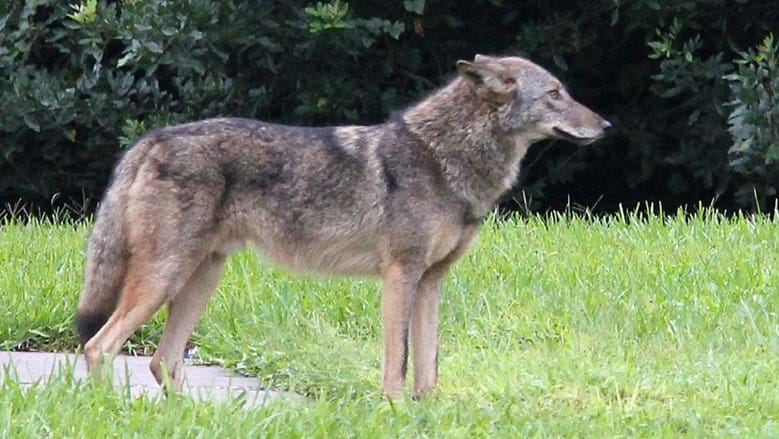
Deerfield-News.com-Deerfield Beach,Fl-.In a rare daytime appearance, a coyote was between Berkshire A and Upminster M. And then it headed toward the grassy section of Upminster. Many readers know I have posted what to do about coyotes from the FWC dozens of times. Below is again what the FWC has to say about coyotes in Florida.
Cover photo FWC -Video Deerfield News Inc. Copyright all rights reserved.
Living with Coyotes
Coyotes are found throughout Florida. According to a 2007 FWC report, the presence of coyotes has been documented in all 67 Florida counties. Coyotes arrived in Florida as part of natural range expansion from western states; they now live in every state but Hawaii. This medium-sized canine, a close relative of the domestic dog, is extremely adaptable and can be found in rural, suburban and urban landscapes. They are typically shy and elusive but encounters between people and coyotes in Florida are occurring more often.
Want to learn more about coyotes?
Join us for a virtual coyote webinar hosted live by an FWC biologist at 7PM, Tuesday, August 5th.
Coyotes help maintain balanced ecosystems by controlling the populations of rodents and smaller predators, such as foxes, opossums and raccoons, which naturally occur in higher densities and can quickly overpopulate areas of habitat. Coyotes are native to North America, have been in Florida for many years, and will continue to make their homes around the state.
Coyotes in Florida: Here to Stay
Removing coyotes for the purpose of eradication is an inefficient and ineffective method to control populations. New coyotes move into areas where others have been removed. Removal activities such as hunting and trapping place pressure on coyote populations, and the species responds by reproducing at a younger age and producing more pups per litter; populations can quickly return to their original size.
Coyotes are in Florida due to natural range expansion from western states. Coyotes now live in every state but Hawaii. Visit the FWC Coyote Species Profile for additional information about coyote biology.
How to Haze Coyotes
This short, educational video discusses how to effectively “haze” or deter coyotes. Coyotes in urban areas may learn to tolerate human presence instead of fleeing. Hazing is the process of disturbing an animal’s sense of security so it leaves an area or otherwise changes its behavior. Methods of hazing may include the use of audible, visual or physical devices or actions to cause the desired reaction.
Coyote reacting to an audible alarm deterrent
Using deterrents such as motion-activated sprinklers or audible alarms can help haze and scare away coyotes and other wildlife from your property and encourage them to leave the area. This video shows an audible alarm at work, effectively deterring a coyote (note: turn your volume down before playing, as the alarm is loud!).
Coyotes are not large animals and rarely pose a threat to people, especially adults. They can be curious but are also timid and generally run away if challenged. If a coyote approaches too closely, there are methods you can use to deter it and frighten it away. Hazing the animal by making loud noises and acting aggressively will typically cause a coyote to leave an area, but you may need to increase and continue hazing efforts until the coyote is effectively deterred and leaves the area for good. There are several methods of hazing that are effective with coyotes.
Prevent Problems with Coyotes
Never feed coyotes either intentionally or unintentionally. This includes placing food outside to attract wildlife. Clean up pet food, fallen fruit and seed around bird feeders – coyotes are opportunistic feeders and will be drawn to and eat all of these potential food sources. Secure garbage cans and secure compost. Close off crawl spaces under porches and sheds to prevent coyotes and other animals from resting or raising their young in areas around your home. Educate your neighbors and ask them to follow these same steps.
FWC can help educate your community about coyotes. Contact your FWC Regional Office to request coyote outreach.
Coyotes that associate places where people live as an easy place to find food may gradually lose their natural fear of humans. Be aware of unusual coyote behavior. Unusual behavior could include a coyote that has lost its fear of humans and is approaching people, chasing joggers and bikers, or attacking leashed pets. Unusual coyote behavior can be reported to your nearest FWC Regional Office.
Interactive Coyote Map
This map shows coyote reports from the FWC’s Wildlife Incident Management System.
Coyotes can and do prey on domestic cats and small dogs. Most coyote attacks on pets occur either at night or in the early evening or morning hours (dusk and dawn). To protect your pets, do not allow them to roam freely. Keep cats indoors. Free-roaming cats are at a high risk of being preyed on by coyotes and other animals. Walk small dogs on a short leash that is less than six feet, especially at night, dusk or dawn. Be extra careful if you are going to walk your pet in wooded areas or areas that have heavy foliage, where coyotes may rest.
Spanish Language Resource: Proteja a su Mascota de los Osos Negros y los Coyotes
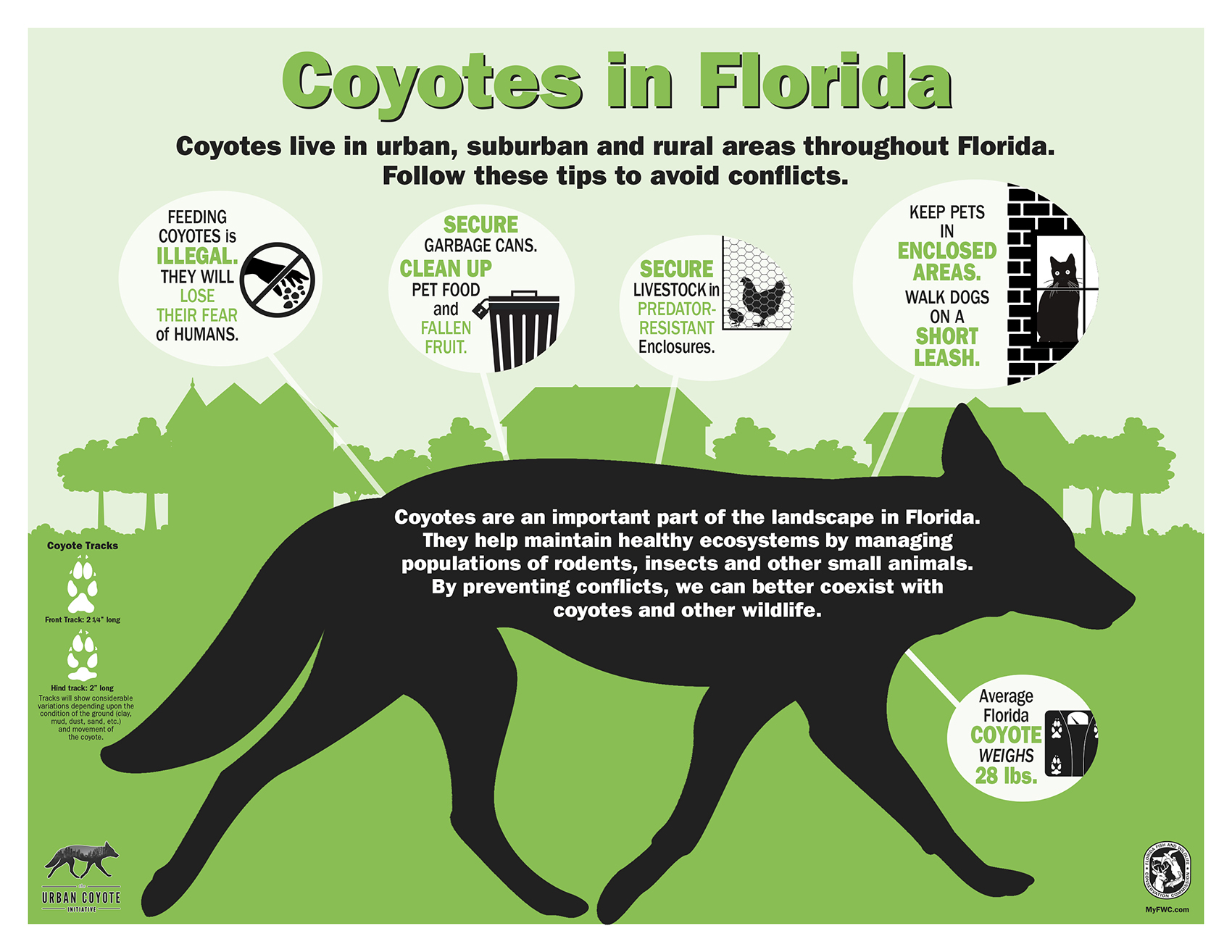
- Feeding Coyotes is illegal. They will lose their fear of humans.
- Secure garbage cans. Clean up pet food and fallen fruit.
- Secure livestock in predator-resistant enclosures.
- Keep pets in enclosed areas. Walk dogs on a short leash.
Coyotes are an important part of the landscape in Florida. They help maintain healthy ecosystems by managing populations of rodents, insects and other small animals. By preventing conflicts, we can better exist with coyotes and other wildlife.
The average Florida coyote weighs about 28 pounds and has a paw track about 2 inches long.
This infographic was developed with assistance from the Urban Coyote Initiative
Appearance:
The coyote is a member of the dog family. They weigh between 20 and 30 pounds, have pointed ears, a narrow muzzle, and bushy tail. Males tend to be larger than females. Pelts are usually grayish-brown, but occasionally black, often with a patch of white chest hair. When running, coyotes usually hold their tails extended out behind them at “half-mast.” Coyote tracks are narrower and more elongated than dog tracks.
Habitat:
Coyotes are native to North America. Once strictly a western species, coyotes now occur throughout the eastern United States. Coyotes began expanding their range into northwestern Florida in the 1970s, and are now considered to be a naturalized species in all 67 Florida counties. They are extremely adaptable; just about any type of forest or farmland is suitable habitat. They can also adapt to and live in suburban and urban areas.
Behavior:
The scientific name of the coyote, Canis latrans, literally means “barking dog.” Coyotes make a variety of vocalizations from barking to shrill yips and howls. They are active day or night, but usually most active at sunset and sunrise.
Coyotes are territorial. A resident pair will establish a territory shared only by other members of their family group.
A coyote’s home range varies from 1,500 to 12,000 acres depending on the individual, food availability and other factors. Coyotes established in urban areas have smaller home ranges than coyotes in rural areas.
Coyotes eat a variety of plants and animals including fruits, insects, rats and mice, rabbits, birds, deer, livestock, virtually any type of carrion, and people’s trash and pet food. They usually hunt alone, sometimes as a pair, but rarely as a group.
Coyotes have one breeding cycle per year. They can first breed when they are 10 months old. Breeding occurs in late winter and following a 63-day gestation period, 4 to 6 pups are born. They den in hollow logs, brush piles and burrows. Pups emerge from dens when they are about 3 weeks old. Parental care lasts until the pups are about 9 months old. The young usually then disperse to a new area, where they establish their own breeding territories. Some pups, however, may stay in their parents’ territory and assist with rearing the next year’s litter.

Coyotes live in urban, suburban, and rural areas throughout Florida. Follow these tips to avoid conflicts.
- Feeding coyotes is illegal. They will lose their fear of humans.
- Secure garbage cans. Clean up pet food and fallen fruit.
- Secure livestock in predator-resistant enclosures.
- Keep pets in enclosed areas. Walk dogs on a short leash.
Additional Information:
- Living with Coyotes
- Protect Your Pets from Coyotes and Bears
- Proteja a su Mascota de los Osos Negros y los Coyotes
- FAQs: Coyote (Canis latrans)
- Coyotes in Florida Infographic Poster
- 2007 Report on Coyote in Florida
- University of Florida information and research
- Living with Urban Coyotes brochure
- Cómo coexistir con Coyotes en entornos urbanos